Douglas Hart

Douglas Hart on the Jesus and Mary Chain, filming rock 'n' roll without the nonsense — and the possibility of finally making another record.

KULTUR // InterviewPage 01

Super 8 · the Mary Chain · filming rock ’n’ roll without the nonsense

Douglas Hart

Douglas Hart on the Jesus and Mary Chain, filming rock ’n’ roll without the nonsense — and the possibility of finally making another record.

Interview · Douglas Hart in conversation

When Douglas Hart received his first proper money from the Jesus and Mary Chain, he did not rush out and buy a better bass guitar. He bought a Super 8 camera. This perhaps tells you everything you need to know about his priorities.

“When I was a kid, you could never afford one,” he says. “It was fucking super-middle-class.”

The camera was less a career move than the fulfilment of a childhood fantasy. Hart had no particular plan to become a filmmaker and certainly hadn’t imagined making a living from it. He simply wanted to shoot film. But musicians he knew began asking him to make things for them: My Bloody Valentine, Kid Congo Powers and Nick Cave, then playing with the Bad Seeds.

“Nick said, ‘Come and do something for me.’ So I made a couple of music videos. It never even occurred to me that I could use film to make a living.”

Buying the Super 8 before the bass wasn’t quite the act of musical treason it appeared.

For around five years, filmmaking overlapped with his life in the Mary Chain. Gradually, the second occupation began to feel less like a sideline and more like a way forward. “After a while, I just thought, ‘Fuck, I could do this.’”

Hart’s relationship with the Jesus and Mary Chain stretched back long before records, tours or even much evidence of a band. He met Jim Reid during his first year at secondary school. Hart was 13, although by his own account he looked closer to ten; Reid was several years older and about to leave school for factory work.

Hart would go round to Reid’s house to listen to records. His youthful appearance occasionally made the arrangement look rather more suspicious than it was. “I’d knock on the door and ask, ‘Is Jim in?’ I think his parents genuinely thought there was a bit of Jimmy Savile business going on.”
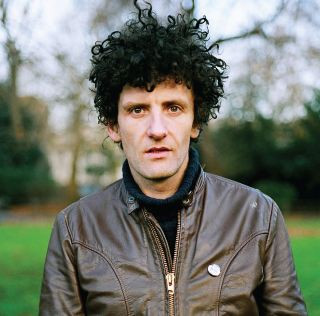
Douglas Hart, portrait in a leather jacket, park, London
Douglas Hart · London, 2025
KULTUR · No. 2 · Douglas Hart01
KULTUR // InterviewPage 02

Continued · Jim Reid’s front door, Munki, Japanese eBay and Paul Weller

Is Jim In?

There wasn’t. There were just records, ideas and the beginnings of a band that would eventually make Psychocandy: an album that sounded like Phil Spector’s studio being demolished with the Ronettes still inside it.

Decades later, the Mary Chain’s records continue to be reissued and rediscovered. Jim and William Reid have returned to the stage, taking Psychocandy back on the road. Hart appreciates the affection for the old material, but nostalgia alone doesn’t interest him greatly. “Those records endure. But more important than going out and playing Psychocandy and re-releasing it is making new records.”

It’s been a kind of sin.

In Hart’s estimation, the group never made a bad one. Even Munki, the Mary Chain’s final album before their long separation, deserves far more credit than it receives. “It’s one of the best. It’s been a kind of sin that they haven’t made a new record for almost 20 years.”

Hart has continued making music himself, although with a characteristically handmade approach. A small label released one of his records online in an edition of 500. Hart made every sleeve individually, incorporating strips cut from Super 8 film, so that no two copies were quite the same. He wasn’t convinced anyone would buy it. All 500 disappeared. “They sold literally all over the world. I suppose these days the link just bounces around.”

That international connection takes the conversation towards Japan, where Hart played twice with the Mary Chain — in Tokyo and Osaka, probably in 1987 and 1989. He hasn’t returned since, although Japan remains a persistent presence in his life, not least through the vintage clothes he buys using online proxy sites. “You get some kid in Japan who’ll bid on Japanese eBay for you and send it over as a gift. You can get things cheaper there. If you buy them from shops here, they fuck you for tax.” It may not be the official slogan of the Japanese tourist board, but it is difficult to argue with the logic.

Since leaving the Mary Chain, Hart has quietly become one of British music’s most distinctive directors. His subjects have included The Stone Roses, Primal Scream, The Horrors, Paul Weller and younger groups such as Yak. Despite the stature of the artists, Hart’s films rarely involve convoys of production vehicles or a small army communicating through headsets. He prefers a handful of people, a direct idea and as little fuss as possible.

His method is based on looking closely rather than imposing spectacle. Musicians are usually filmed in places where they appear comfortable, allowed to look and behave like themselves.

The best compliment

Paul Weller, who has appeared in hundreds of films since joining The Jam as a teenager, told Hart he found most of them unbearable: “Ninety-nine per cent of the videos I’m in, I watch them back and think I look like a dick. I can’t watch them. But the ones you make, I think: That’s me. I can see myself.

Hart’s films work because he doesn’t force musicians into borrowed narratives. “Some people are into having a narrative thrust onto the song. But these are people who genuinely love rock ’n’ roll. There’s power in seeing the style of the band and their performance — just giving it everything. You can’t really beat that.” Watch old footage of Jerry Lee Lewis and there is no concept to decipher, no mood board. “It’s very simply shot. It’s just capturing his fucking essence and performance. There’s nothing more exciting.”

Perhaps that is why buying the Super 8 before the bass wasn’t quite the act of musical treason it appeared. Hart had already understood that rock ’n’ roll was as much something to be seen as heard. He just needed a camera small enough to get close to it.

KULTUR · No. 2 · Douglas Hart02