James Joyce, 1939 · the book with no full stop · 628 pages of weather
FINNEGANS WAKE
Seventeen years, forty languages, one sentence that never closes. A field guide to the least readable masterpiece in English — and why that is exactly the point.
Words · KULTUR
It is not a novel with a plot, characters you can hold, or prose that behaves itself. Finnegans Wake is a text assembled from puns, fragments, myths, songs, jokes, historical debris and half a dozen tongues at once.
Joyce had already rebuilt the modern novel with Ulysses. Here he went further — attempting a book that does not narrate so much as reproduce the way sleep, memory, history and language actually move. It resists you. That is the design.
The book is a circle
The most famous feature of the Wake is its circular structure. It begins in the middle of a sentence and ends with the words that complete it. The end flows back into the beginning. There is no final stopping point, and no correct place to start.
The book is built on the idea that life, history and storytelling repeat themselves. Everything falls, rises, changes form and begins again. Joyce takes this from the philosopher Giambattista Vico, who argued that civilisations pass through a divine age, a heroic age and a human age before collapsing into chaos — and starting over.
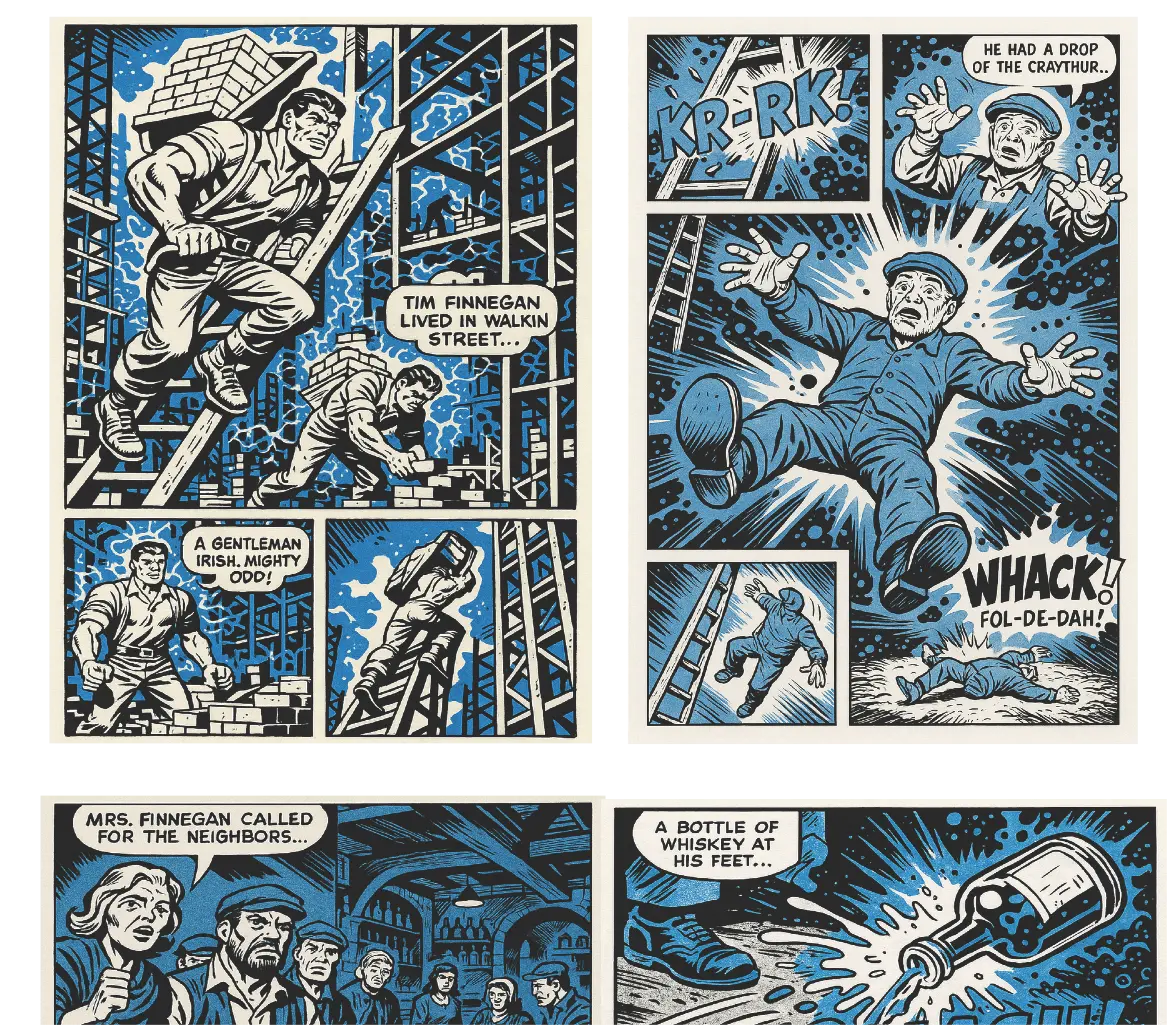
So the fall of one man becomes the fall of a civilisation, which becomes the fall of Adam, which becomes Humpty Dumpty off the wall, which becomes any human mistake at all. The personal, the historical, the religious and the frankly comic all turn out to be the same shape seen from different distances.
The File — FW / 1939 / DUBLIN: 17 years in the writing. 628 pages, ending mid-clause. 40+ languages folded in. 1 sentence, running end to start.